
Hazardous Waste Life Cycle – Cradle to Grave – Every Step Matters
GET A DEMO OF CRADLE TO GRAVE WASTE TRACKING
The Hazardous Waste Life Cycle at a Glance
For a large quantity generator (LQG), hazardous waste management does not begin when a drum is ready for pickup—and it certainly does not end when a transporter drives it off site.
It is a cradle-to-grave process.
From the moment hazardous waste is generated, through identification, accumulation, inspection, shipment, transportation, treatment, storage, disposal, manifest return, and final reporting, every step creates an opportunity to either strengthen—or weaken—your compliance program.
For U.S. facilities operating as LQGs, the stakes are particularly high. Under federal RCRA regulations, an LQG generally generates 1,000 kg (2,200 lb) or more of hazardous waste in a calendar month, or more than 1 kg of acute hazardous waste. LQGs are subject to the full set of federal hazardous-waste generator requirements under 40 CFR Part 262. (US EPA)
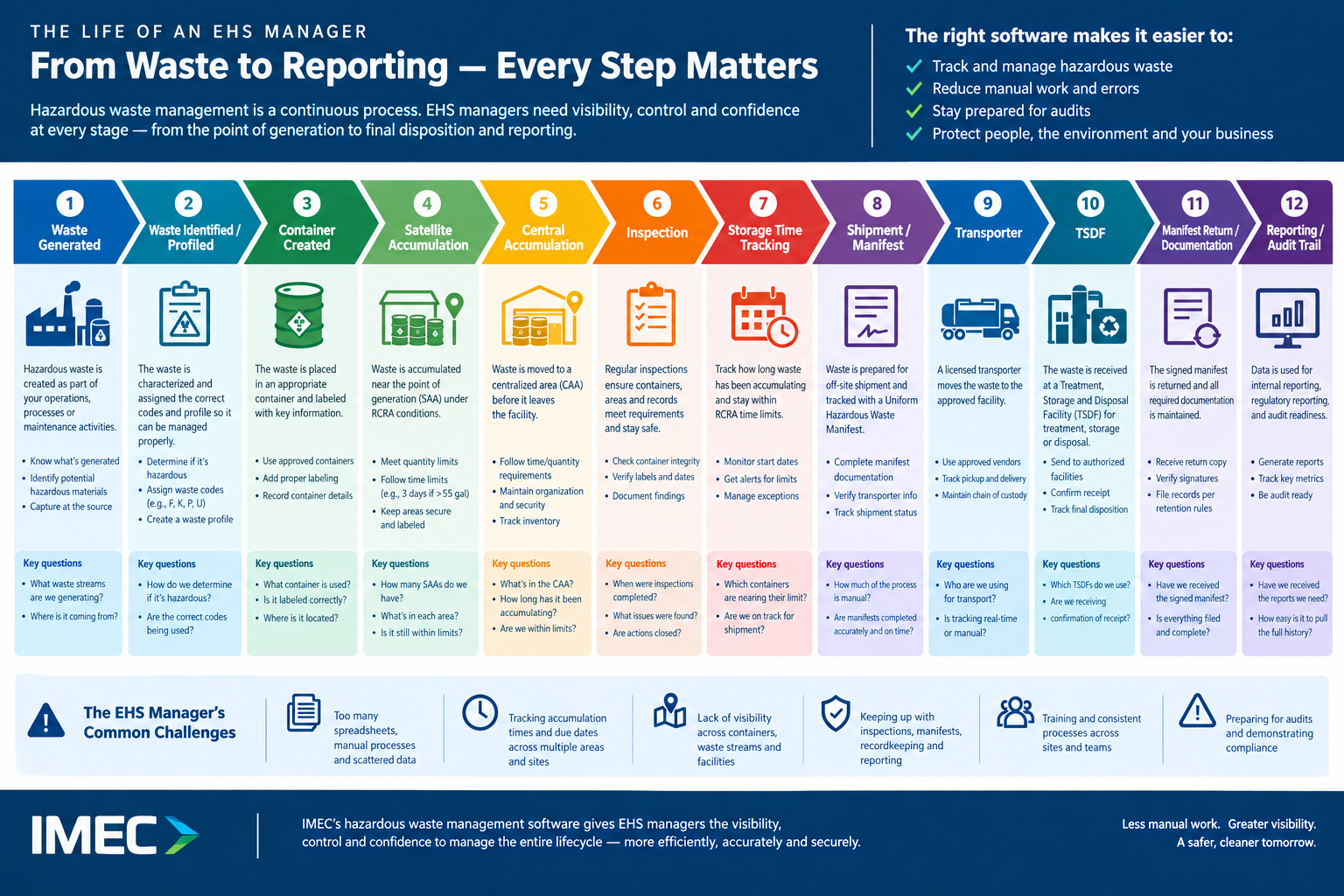
The infographic accompanying this article illustrates that lifecycle as 12 connected steps. The key message is simple:
Hazardous waste compliance is not a single task. It is a chain of connected activities—and every link matters.
For a large quantity generator, the lifecycle can be viewed as:
- Waste Generated → 2. Waste Identified/Profiled → 3. Container Created → 4. Satellite Accumulation → 5. Central Accumulation → 6. Inspection → 7. Storage Time Tracking → 8. Shipment/Manifest → 9. Transporter → 10. TSDF → 11. Manifest Return/Documentation → 12. Reporting/Audit Trail
Each stage produces information that is needed at the next stage.
A waste profile influences the container and labeling requirements.
The container affects accumulation management.
Accumulation affects storage deadlines.
Storage information feeds shipment planning.
The shipment depends on accurate manifest information.
The manifest connects the generator to the transporter and receiving facility.
And ultimately, the entire lifecycle becomes part of the facility’s compliance and reporting record.
That is why managing these activities in isolation can create gaps.
Step 1: Waste is Generated
The lifecycle begins at the point where a process, maintenance activity, laboratory operation, production line, or other activity generates waste.
For an EHS manager, the first question isn’t simply:
“What waste do we have?”
It is:
“Where is waste being generated, what is generating it, and how do we know about it?”
EPA’s hazardous waste identification requirements require generators to determine whether their solid waste is hazardous under 40 CFR Part 261 and 40 CFR §262.11. (US EPA)
That means visibility at the source is fundamental.
Typical questions include:
- What waste streams are being generated?
- Which processes are generating them?
- Where are they being generated?
- How much is being generated?
- Is the waste potentially hazardous?
- Are new or changed processes creating new waste streams?
For an LQG, this information also feeds into monthly generator-status determinations. EPA states that hazardous waste generated in satellite accumulation areas is included when determining generator category. (US EPA)
Why this matters
If waste isn’t captured correctly at the point of generation, everything downstream can be affected—from waste classification to accumulation tracking and reporting.
Step 2: Waste is Identified and Profiled
Once a waste stream is identified, it needs to be properly characterized.
This is where the waste profile becomes the foundation for the rest of the lifecycle.
The generator must determine whether the waste is hazardous and, where applicable, identify the appropriate EPA hazardous waste codes and characteristics.
Depending on the waste stream, the determination may involve:
- Generator knowledge
- Safety data sheets
- Process information
- Laboratory analysis
- Previous analytical data
- Applicable hazardous waste listings
- Ignitability, corrosivity, reactivity, or toxicity determinations
EPA identifies waste identification as the first major step in complying with hazardous waste regulations. (US EPA)
For an LQG, waste determination records are also part of the compliance record and should be maintained appropriately. EPA’s LQG guidance identifies waste determination documentation, test results, and waste analyses among the records subject to retention requirements.
The practical challenge
A waste profile sitting in a spreadsheet or email may technically exist—but can it be quickly connected to the actual container sitting on the plant floor?
That connection is where good hazardous waste management systems can make a significant difference. IMEC’s software holds a waste profile master record for each waste stream, holding all the regulatory information needed to manage, track, ship and report on that waste profile.
Step 3: Creating a Container
After the waste has been identified, it has to be placed into an appropriate container or management unit.
At this stage, the physical waste and its digital record come together.
Important information can include:
- Waste stream/profile
- Container type, 55 gallon drum, Tote etc
- Container ID, the unique tracking ID/QR code within the IMEC software
- Hazard information
- Accumulation location
- Date information
- Quantity
- Generating department
For containers managed under satellite accumulation provisions, EPA requires specific conditions to be met, including limits on the amount that may be accumulated and requirements concerning containers and labeling.
The goal:
Know what is in the container, where it is, when it was generated, and what requirements apply to it.
Step 4: Satellite Accumulation Areas
For many industrial facilities, hazardous waste first accumulates near the point where it is generated.
These areas are known as Satellite Accumulation Areas (SAAs).
Federal regulations allow LQGs to accumulate up to 55 gallons of non-acute hazardous waste at an SAA, subject to the conditions of 40 CFR §262.15. There are separate limits for acute hazardous waste.
This stage can become challenging in a large facility.
Imagine dozens—or hundreds—of accumulation points spread across:
- Production areas
- Maintenance shops
- Laboratories
- Outdoor process areas
The EHS team needs visibility across all of them.
Questions an EHS manager should be able to answer
- Where are our SAAs?
- What waste is currently accumulating there?
- How much waste is present?
- Are containers properly identified and managed?
- When does waste need to move to central accumulation?
Step 5: Central Accumulation Area:
From the satellite area, waste moves into a central accumulation area before being shipped off site.
For an LQG, hazardous waste may generally be accumulated without a storage permit for 90 days or less. This makes date tracking critical.
A central accumulation area needs more than a collection of drums.
It needs a controlled system for knowing:
- What waste and quantities are present?
- When did accumulation begin?
- When does the applicable accumulation period expire for each container?
- Has the area been inspected?
The clock matters
One of the most important pieces of information associated with a hazardous waste container is its accumulation start date.
Missing a date—or relying on a handwritten label that is difficult to interpret months later—can create unnecessary compliance risk.
IMEC’s software provides email alerts of waste containers nearing the accumulation date. The email alert lists each container, days remaining and location. This can then be used to easily generate a shipment.
Step 6: Storage Time Tracking
For an LQG, accumulation time is one of the critical compliance clocks.
Under the federal generator standards, LQGs generally have a 90-day accumulation period for hazardous waste managed under the applicable generator accumulation provisions. (US EPA)
That creates an operational question:
Which containers are approaching their deadline?
A good system should make this visible before a deadline becomes an emergency.
Instead of discovering that a drum has been sitting in central accumulation for too long, the EHS team should be able to see:
Container → Waste Stream → Location → Accumulation Start Date → Days Remaining → Shipment Status
Storage time email alerts of waste containers nearing the accumulation date are provide within IMEC’s solution. The email alert shows each container, deadline and location. This is one of the clearest examples of where centralized tracking can reduce manual work for EHS Managers.
Step 7: Shipment and Manifest
For off-site shipments, the Uniform Hazardous Waste Manifest provides the core documentation connecting the generator, transporter, and receiving facility.
EPA describes the manifest system as a mechanism for tracking hazardous waste from the generator facility through transportation to the off-site facility that will store, treat, or dispose of it.
The manifest captures important information about the shipment, including:
- Generator information
- Waste streams
- EPA waste codes
- Quantities
- Handling information
- Transporter information
- Destination facility
- Required signatures
Step 8: Transporter
Once the waste leaves the facility, an approved hazardous waste transporter moves it toward its designated destination.
From the generator’s perspective, this means transporter information should be part of the shipment record.
The EHS team should be able to answer:
- Who transported the waste?
- Was the transporter properly authorized?
- What shipment was picked up?
- When was it picked up?
- Which manifest was associated with the shipment?
- Where was it going?
- Has delivery been confirmed?
This is particularly important when multiple transporters, waste vendors, or facilities are involved.
Step 9: Treatment, Storage and Disposal Facility - TSDF
The waste arrives at the TSDF. At this stage, the generator may no longer physically possess the waste—but the generator’s compliance responsibility does not simply disappear.
The receiving facility’s role can include:
- Receiving the shipment
- Verifying the manifest
- Managing the waste
- Treating the waste
- Storing the waste
- Recycling or reclaiming it, where applicable
- Disposing of it
- Completing the appropriate manifest process
The manifest is the documentation that connects these stages.
Once the waste reaches its destination, the receiving facility provides the signed documentation confirming receipt.
Step 10: Manifest Return and Documentation
This is one of the most overlooked stages in the hazardous waste lifecycle.
For an EHS manager, shipment closure should mean more than “the vendor picked it up.”
The organization should be able to reconcile:
Waste container → Shipment → Manifest → Transporter → Receiving facility → Signed receipt → Final documentation
This is where an incomplete manifest record can become a problem.
At 45 days if a signed manifest is not received, the LQG must contact the transporter to determine the status of the hazardous waste.
At 60 days if the status remains unconfirmed then the LQG must submit an EPA Exception Report.
The key question:
Can you prove where every shipment went and close the loop with the final documentation?
IMEC’s software helps LQGs track manifest returns by sending email alerts for any manifest that is not complete at 30, 45 and 55 days.
Step 11: Reporting
The final stage of the lifecycle is reporting—but in reality, reporting is built from everything that happened before it.
For LQGs, federal regulations require a Biennial Report covering the nature, quantities, and disposition of hazardous waste generated at the facility. EPA states that the report is generally due to the authorized state agency or EPA regional office by March 1 of each even-numbered year, covering the previous calendar year’s activities. (US EPA)
That means the information required for reporting has to be available long after individual waste containers have left the site.
Step 12: Inspections
Hazardous waste areas require weekly inspections.
An effective inspection program should address:
- Container condition
- Container closures
- Labels
- Leaks or releases
- Aisle space
- Emergency equipment
- Signage
- Secondary containment, where applicable
- Storage-area housekeeping
For LQGs, inspection and emergency preparedness are part of the broader regulatory framework governing hazardous waste accumulation and management.
But inspections are only useful if the resulting findings are acted upon.
A system that records an inspection but does not track corrective actions can leave the EHS manager with another spreadsheet—and the same problem next month.
IMEC’s Inspection App provides the ability to build custom forms, perform inspections, create corrective actions, with email alerts. Corrective action management is also included which ensures that corrective actions are allocated to the correct person and are closed off within the allowable time frame.